Camel Riding & Bedouin Culture in Wahiba Sands
A camel does not stand up gently. It heaves you skyward back legs first, and suddenly you are swaying two metres above the sand. Here is the truth about riding them, and about the culture they belong to.
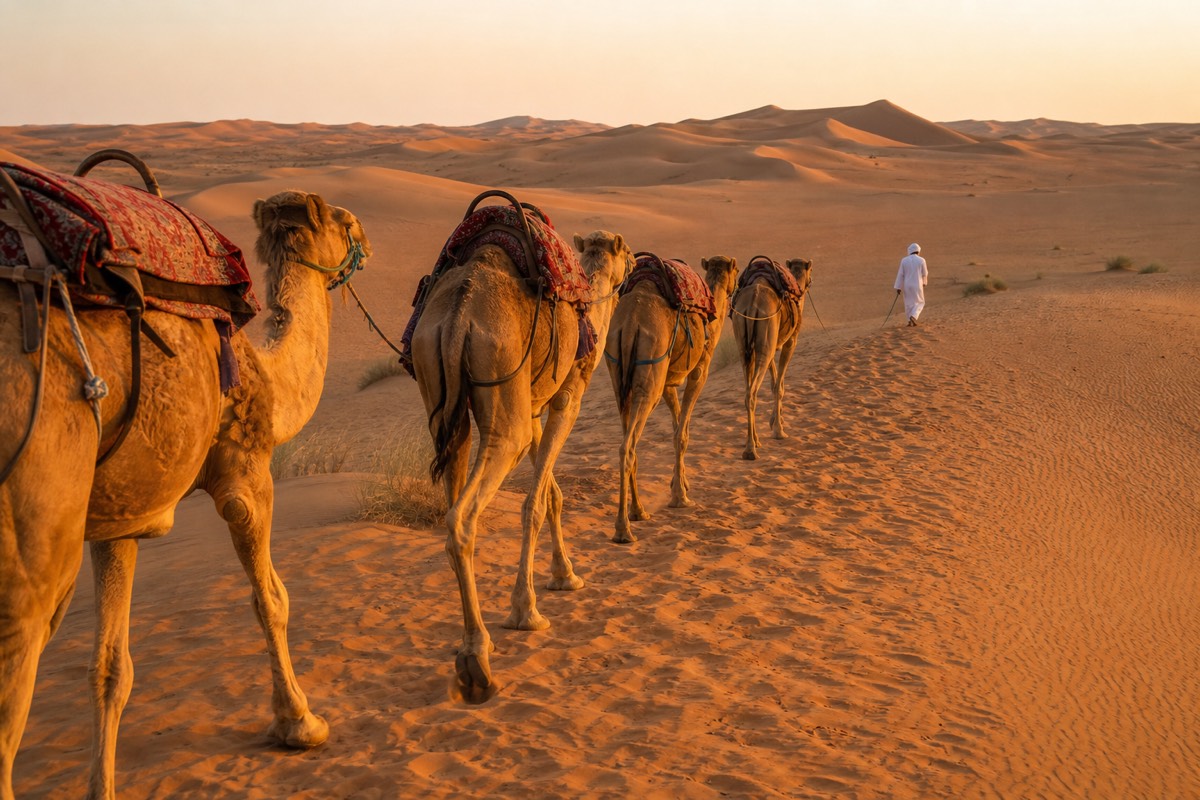
Bedouin etiquette, at a glance
The customs that matter on a family visit: right hand for eating and greeting, modest dress, and accepting the coffee and dates you are offered.
What is a camel ride here actually like?
A camel ride in the sands is a slow, swaying walk across the dunes on a seated saddle, led by a handler on foot. The camel kneels for you to climb on, then lurches up in two lunges. Most tourist rides last 15 to 45 minutes at walking pace. It is gentle and scenic, not a gallop, with suitability depending on the operator’s restrictions.
Match the departure point, trip length and included activities to the plan above.
At A Glance: English- or Arabic-guided safari with camel riding, dune driving, sand skiing and a Bedouin house visit.
Explore The Bidiyah Camel SafariThe drama is all in the mount. You climb onto the saddle while the camel is folded down on the sand, and then it stands, back legs first, pitching you forward, before the front legs straighten and rock you back. Lean back as the rear rises, forward as the front follows, and hold the saddle horn. After that it settles into a rolling, unhurried gait that feels like being on a small boat. These are dromedary, the one-humped Arabian camels bred for exactly this ground.
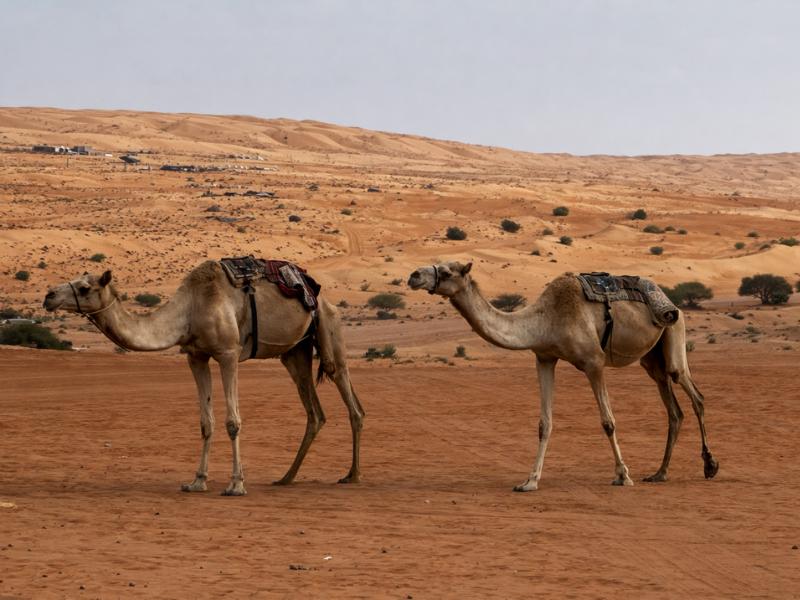
What you get is not speed but perspective. From up high the dunes reveal their shape, ridge after ridge, and the pace forces you to slow down and actually look. A handler leads on foot or on another camel, and the whole thing is calm enough that children and nervous first-timers manage fine. The table sets out the ride formats you will typically be offered.
| Format | Typical length | Good for |
|---|---|---|
| Short taster | 10 to 15 minutes | A first try, photos, kids |
| Standard ride | 20 to 45 minutes | Most visitors, a proper feel for it |
| Sunset ride | 30 to 60 minutes | The best light, the classic experience |
| Longer trek | 1 to 2 hours | Keen riders wanting distance and quiet |
One honest note: a camel is a living animal, not a machine, and each has a temperament. Handlers know their animals and match calmer camels to nervous riders. If you are anxious, say so, and ask for a short taster before committing to a longer ride. Nobody will push you onto a longer trek than you want.
Curious about discovering a local camel outing? Discover a camel ride included with sand skiing and a Bedouin house visit.
Dates and booking provided by GetYourGuide. If the calendar cannot load, use the booking link below.
Discover The Bidiyah Camel Safari2 hours · Bidiyah meeting point
Food and tips excluded. Not suitable for back problems or mobility impairments. Confirm child restrictions and the exact meeting point.
How long, how comfortable, and does it hurt?
A ride is comfortable for most people up to about 45 minutes; beyond that the sway can tire your back and inner thighs. It does not hurt if you sit upright and move with the camel rather than bracing against it. Longer treks are for the keen. If you have a back condition, follow medical advice and the operator’s restrictions, and expect to feel it a little the next day.
The rolling motion is the thing to understand. Your hips rock side to side with each step, and your core does quiet work keeping you upright. For 20 to 45 minutes that is pleasant. Push past an hour and muscles you forgot you had start to complain, especially the inner thighs and lower back. This is why the standard tourist ride is short, and why a two-hour trek is a genuine, if mild, physical undertaking.
Comfort comes down to posture and pace. Sit tall, let your pelvis follow the sway, and do not grip with your knees the whole time. The handler keeps the pace to a walk, which is the comfortable speed; a trotting camel is a different and much bumpier animal that tourist rides avoid. If you have back or hip issues, the same honesty that applies to dune bashing applies here: follow medical advice and the operator’s restrictions rather than assuming a shorter ride is suitable.
Animal welfare is a fair thing to think about, and a quick look tells you a lot. Healthy camels look it: alert, well-fed, with clean, sores-free backs and saddles that sit on padding rather than bare hide. Reputable handlers work their animals in rotation, rest them in shade, and keep water nearby, and they will not push a tired camel out in the worst of the heat. If a camel looks thin, distressed or overloaded, you are within your rights to decline the ride, and the better operators would rather you did than prop up poor practice.
The listed camel safari is not suitable for back or mobility problems. A shorter ride does not override those restrictions; no suitable alternative was verified for those requirements.
What happens when you visit a Bedouin family?
A Bedouin visit usually means being welcomed into a home or majlis on the sand, sat on rugs and cushions, and offered coffee and dates while you talk, often through your guide. You may see how they live with goats and camels, hear about desert life, and be shown small crafts. It is hospitality first, a cultural window second.
Bedouin hospitality is not a performance bolted onto a tour; it is the living centre of it. The word Bedouin means desert-dweller, and the families who still keep herds in the sands carry a tradition of welcome that treats a guest as an honour rather than an interruption. On a visit you are typically seated on the ground in a shaded majlis or tent, greeted warmly, and offered the coffee and dates that open every encounter.
| Element | What to expect |
|---|---|
| Welcome | Seated on rugs, greeted, coffee and dates offered at once |
| Conversation | Talk about desert life, often through your guide as interpreter |
| Animals | Goats and camels nearby, sometimes a chance to help feed them |
| Crafts | Weaving, rope-making or simple goods, sometimes for sale |
| Home life | A glimpse of how a semi-nomadic household is run |
The tone is unhurried and personal. You are not being processed through an exhibit; you are a guest for half an hour or so. Bring genuine curiosity and a few respectful questions, and let your guide translate. Many families keep a foot in both worlds now, a pickup truck beside the camels, a phone charging off a solar panel, and that mix is part of the honest story of desert life today rather than a sign of anything lost.
On gifts and money, keep it simple and low-key. A small tip for a handler or a token gift is welcome but never expected, and haggling hard over a length of woven cloth misses the spirit of the visit. If you buy a craft, pay fairly and cheerfully; if you do not, a warm thank-you is enough. Trying to press cash on a host as payment for their hospitality can even feel awkward, since the coffee and the welcome are freely given, not sold.
Plan for visiting a Bedouin home during the outing: check your date before arranging the rest of your trip. This option includes a Bidiyah safari with a house visit and English or Arabic guide.
Check Dates For The Bidiyah Camel Safari2 hours · Bidiyah meeting point
Food and tips excluded. Not suitable for back problems or mobility impairments. Confirm child restrictions and the exact meeting point.
What is the coffee and dates ritual, step by step?
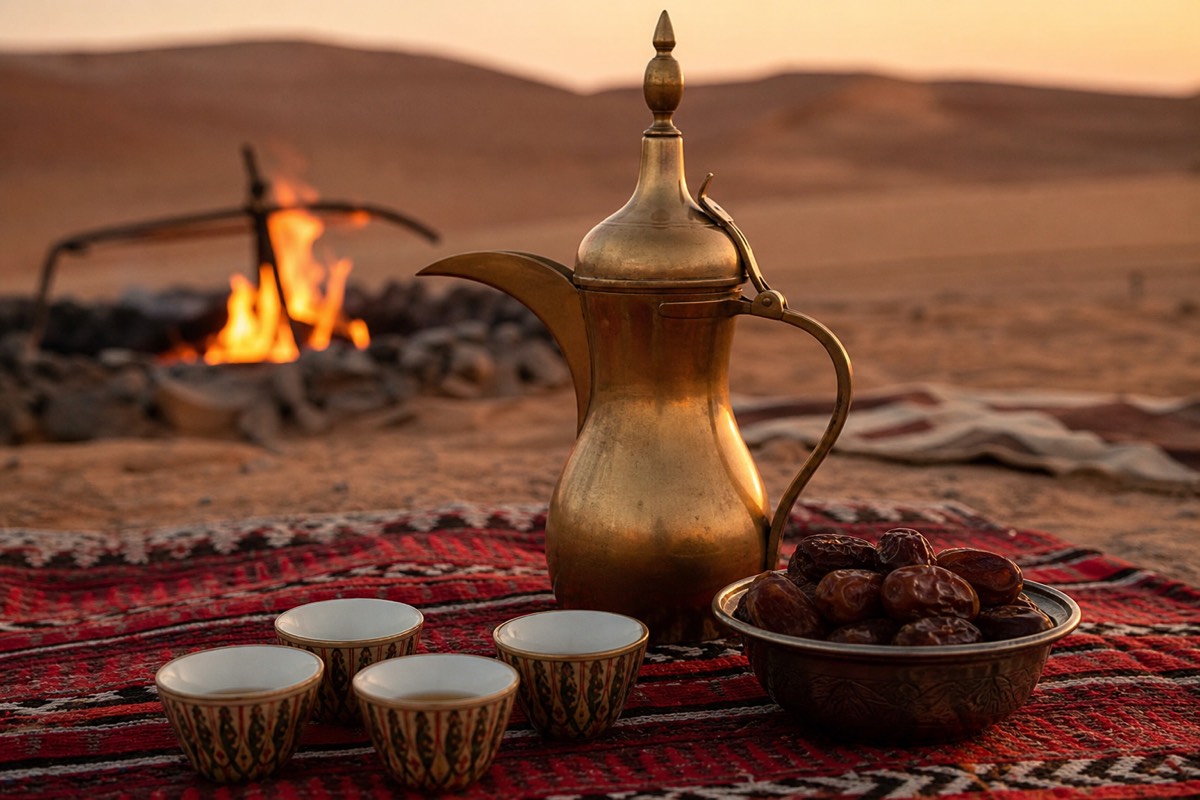
The welcome is Omani coffee, kahwa, lightly roasted and spiced with cardamom, served in tiny handleless cups alongside dates. Take the cup in your right hand, sip, and it will be refilled until you gently shake or tilt the cup to signal you have had enough. Eating a date first sweetens the bitter coffee. Refusing outright is a snub.
This ritual is the beating heart of the welcome, and it has real depth. Omani kahwa is made from lightly roasted beans ground with cardamom, sometimes scented with rose water or saffron, and brewed in a long-spouted pot called a dallah. It is poured, always with the right hand, into small cups without handles, and it comes with dates to balance the bitterness. The whole custom of Arabic coffee is recognised by UNESCO as part of the region's intangible cultural heritage, a marker of generosity across the Gulf.
| Step | What to do |
|---|---|
| Accept the cup | Take it with your right hand, always |
| Eat a date first | Its sweetness softens the bitter, cardamom-scented coffee |
| Sip, do not gulp | The small cup is meant for two or three sips |
| Want more? | Hold the cup out; it will be refilled |
| Had enough? | Gently shake or tilt the empty cup side to side |
| Never | Refuse the first cup outright, or use your left hand |
The cup-shake is the detail visitors love once they learn it. Without that little wobble, your host will keep topping you up, because stopping first would be inhospitable of them. Two or three cups is a normal, polite amount. Accepting at least one is important: the coffee is the hospitality, so declining it entirely reads as declining the welcome. If you truly cannot drink coffee, accept the cup, take a token sip, and eat a date; the gesture is what counts.
Curious about making hospitality part of the evening? Discover a Bedouin home visit, coffee and Omani dinner on the Bidiyah sunset route.
Scheduled departures from Viator. Availability and final price are confirmed on Viator.
4 hours · Bidiyah meeting point, return to start
Camel riding costs extra. No overnight accommodation. Not recommended during pregnancy. Agree the meeting point before arranging transport.
What etiquette matters most out here?
Dress modestly, use your right hand for eating and greeting, ask before photographing people, and accept hospitality graciously. Cover shoulders and knees, remove shoes if entering a home, and keep public affection to a minimum. What to wear and how to behave are the same courtesy: respect a conservative, generous culture and you will be warmly received.
None of this is complicated, and Omanis are famously forgiving of honest mistakes by visitors. The point is to arrive respectful. Modest clothing does the heavy lifting: loose layers that cover the shoulders and knees suit both the culture and the climate, and a scarf is useful for women near homes or if you want to cover your hair as a courtesy. The right hand rule threads through everything, eating, giving, receiving, because the left is traditionally considered unclean.
| Do | Avoid |
|---|---|
| Dress modestly, cover shoulders and knees | Beachwear or tight clothing at a home or camp |
| Use your right hand to eat and greet | Passing food or a cup with your left hand |
| Ask before photographing people | Snapping women or families without consent |
| Accept coffee and dates warmly | Refusing hospitality outright |
| Remove shoes entering a home | Pointing the soles of your feet at someone |
| Keep voices and affection low-key | Loud groups, public kissing or hugging |
Photography deserves its own line because it is where good intentions most often trip up. The landscape and the camels are free game; people are not. Always ask, and accept a no gracefully, especially with women. A smile and a gesture toward your camera is usually enough to get a yes or a polite shake of the head. Getting this right is the difference between being a welcome guest and an intrusive one, and it costs nothing.
Plan for arriving with a guide for the cultural stop: check your date before arranging the rest of your trip. This option includes an English- or Arabic-guided camel-and-house itinerary.
Check Dates For The Bidiyah Camel SafariWhat is authentic, and what is staged for visitors?
Be honest with yourself: much of what you see on a short tour is arranged for visitors, but it is built on real tradition rather than invented for it. The coffee welcome, the camels and the hospitality are genuine customs; the tidy timing and the gift shop are tourism. Authenticity runs deeper the smaller, slower and more personal the encounter.
It helps to drop the fantasy that you will stumble on an untouched nomad camp frozen in time. Most Bedouin families in the sands now live modern lives alongside their heritage, and the camel rides and family visits on a day tour are, to some degree, set up for guests. That does not make them fake. The coffee ritual is exactly how Omanis welcome any visitor. The camels are real working and racing animals. The hospitality is sincere. What is staged is mainly the packaging: the schedule, the souvenirs, the smoothed-over convenience.
| What you see | How real it is |
|---|---|
| Coffee and dates welcome | Genuine custom, performed for guests but authentic |
| Camels for riding | Real animals, though kept largely for heritage and tourism now |
| Family conversation and tea | Sincere hospitality, the heart of the visit |
| Fixed schedule and souvenirs | Tourism packaging, not tradition |
| Solar panels, pickups, phones | Real modern desert life, not a loss of authenticity |
If depth matters to you, the fix is time and scale. A rushed roadside stop delivers the surface; an overnight at a family-run camp, a smaller group, and a guide with real local ties get you closer to genuine exchange. The operators we work with include family-owned camps where the hosts are the family, and those visits feel different from a conveyor-belt stop. Manage your expectations and you will find the real thing is warmer, and more ordinary, than the postcard version.
The listing verifies a house visit, not an exclusive family relationship or a particular conversation. We do not promise an unstaged encounter.
When is the best time of day to ride?
Sunrise and sunset are the best times, for cool air and gorgeous low light, with sunset the most popular. Midday rides are hot and the light is flat. On an overnight stay you can do both: a sunset ride the evening you arrive, a quiet dawn ride before the heat builds. Early and late are also kinder to the camels.
Camels tolerate heat far better than people, but you still do not want to be swaying along under a midday sun. The magic is at the edges of the day. A sunset ride, camel silhouetted against a burning sky, is the shot everyone comes for, and the air is finally cooling. A dawn ride is quieter and cold-crisp, with the sand pink and the camp still asleep behind you. Both beat the flat, hot middle hours.
| Time | Conditions | Verdict |
|---|---|---|
| Sunrise | Cool, soft light, silent dunes | Peaceful and beautiful |
| Midday | Hot, flat harsh light | Avoid if you can |
| Late afternoon | Cooling, warming light | Very good |
| Sunset | Golden light, cooling air | The classic choice |
Compare the actual itinerary as well as the price. The local Bidiyah sunset trip includes sandboarding and dinner, with camel riding extra. A Muscat shared day has separate standard, sunset and quad choices. The selected option determines what your quote covers. Related reading: best time to visit.
Curious about planning sunset before arranging your camp evening? Discover a local sunset safari with camel riding available at extra cost.
Discover The Bidiyah Sunset TripCamel, 4x4 or quad for exploring the dunes?
They do different jobs. A camel is slow, atmospheric and cultural; a 4x4 covers ground and delivers the dune-bashing thrill; a quad is hands-on fun over shorter distances. Most good days combine them: arrive and drive by 4x4, ride a camel at sunset, and add a quad if you want more activity. You do not have to choose only one.
People sometimes frame this as a contest, but the three ways of crossing the sand answer different wishes. If you want to feel history and slow down, the camel wins. If you want to reach the big dunes and get the stomach-drop of dune bashing, you need a 4x4, and out here you genuinely do need a 4x4 for the soft sand. If you want to steer something yourself over a shorter loop, a quad is the playful middle option.
| Mode | Pace and range | Best for |
|---|---|---|
| Camel | Slow, short, led on foot | Atmosphere, culture, photos |
| 4x4 | Fast, long range, thrilling | Dune bashing, reaching deep sands |
| Quad or ATV | Medium, hands-on, shorter loops | Self-steered fun, adventure days |
The best answer for most visitors is all three, in the right doses. A full day or an overnight naturally layers them: the 4x4 gets you in and over the dunes, the camel gives you the cultural and golden-hour moment, and a quad or sandboard fills any appetite for more action. That variety, rather than any single mode, is what makes a day in the sands feel complete.
Plan for comparing a private day of activity choices: check your date before arranging the rest of your trip. This option includes a Muscat vehicle and guide with dune, quad, camel and board activities charged separately.
Scheduled departures from Viator. Availability and final price are confirmed on Viator.
7 to 8 hours · Muscat pickup and return
Camel riding, quad biking, sandboarding and dune bashing all cost extra. Lunch excluded. Not recommended during pregnancy or for spinal or cardiovascular conditions.
Should you combine a camel ride with an overnight camp?
Yes, if you can. Staying overnight turns a quick camel ride into the fuller Bedouin experience: sunset from the saddle, dinner and coffee at a desert camp, stargazing, and a calm dawn ride before you leave. It also removes the long evening drive home. This is where the culture stops feeling like a stop and starts feeling like a stay.
A camel ride squeezed into a day trip is lovely but brief. Fold it into an overnight and the whole thing deepens. You ride at sunset, share a meal at camp as the air cools, sit under a sky thick with stars, and wake to the dunes at their softest. Wahiba Sands Tours works with overnight camps that build the camel ride, the Bedouin welcome and the evening entertainment into one flowing experience rather than a rushed hour.
Compare the total for your actual dates and party. The verified room-based overnight includes private Muscat transport, a standard Desert Rose Camp room, dinner and breakfast. Lunch and camel riding are extra. A private vehicle does not mean an exclusive or luxury camp.
Curious about adding a camp night to your camel plans? Discover a standard room, dinner and breakfast, with camel riding an extra.
Discover The One-Night Camp Stay